



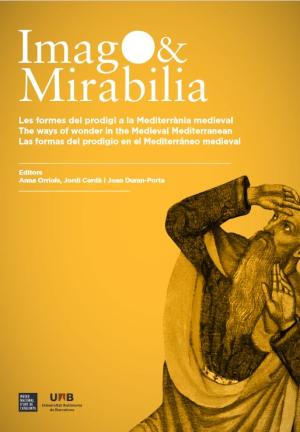
Imago & Mirabilia: Les formes del prodigi a la Mediterrània medieval
Synopsis
In the Middle Ages, the marvelous is real. Chronicles, encyclopedic texts, and both secular and religious literary works are filled with supernatural characters and episodes whose existence is not only unquestioned, but used as justification for and decipherer of reality, because they are a part of it. And, like reality itself, the marvelous is diverse: it is the heritage of ancient tradition, continuously reworked by medieval culture; it is that which takes the form of miracles within the Christian sphere; it is the magical; it is the miraculous artifact, the inexplicable phenomenon, and everything that eludes understanding across all cultural categories. It is, ultimately, everything that evokes wonder. This volume marks the start of an adventure in which the editors have relied on the complicity, expertise, and diverse contributions of the authors behind these studies. Drawing from the fields of art history, philology, history, and philosophy, and hailing from various institutions and countries, they address some of the many facets of the medieval wonder. From these differing perspectives, yet united by a shared goal to decipher the universe of medieval marvels, the contributions collected here are authored by Gianluca Ameri, Miguel Ayres de Campos-Tovar, Michele Bacci, Montse Barniol, Caterina Fernandes Barreira, Pere Beseran, Gaelle Bosseman, Jordi Cerdà, Mattia Chiriatti, Dominique de Courcelles, Sandra Dolz López, Cèsar Favà, Mário Farelo, Carla Varela Fernandes, Avital Heyman, Nikolas Jaspert, Juan Antonio Jiménez Sánchez, Paulo Esmeraldo Catarino Lopes, Pere Maymó i Capdevila, Anna Orriols, Laura Rodríguez Peinado, Meritxell Simó, and Idries Trevathan. Parading through the pages of this book are fabulous objects, stories, places, and characters—whether deemed real or not: sacred geographies, Mount Carmel, scenes of adventure from Arthurian lore; visions, apparitions, and imaginary journeys; animals performing miracles, monsters, nocturnal creatures, and one-handed maidens; enchanted treasures, flying ships, extraordinary relics, and miraculous images; the Antichrist and saints crossing the sea atop clouds. All these cases both draw from and bolster legendary and wondrous tales that represent (only) a few elements of the kaleidoscopic universe of the marvelous. The spirit driving this collection of studies stems from the firm belief in the importance of wonder as a category—as an active protagonist rather than a mere backdrop or minor accessory of a bygone world. A world that the marvelous not only helps to shape but also to explain, for the picture of the Middle Ages would remain incomplete without considering wonder as one of its driving forces.
Downloads
Downloads
Published
Categories
License

This work is licensed under a Creative Commons Attribution-NonCommercial-NoDerivatives 4.0 International License.


